
Color Psychology in Design

Color psychology in design, How Colors Speak to the Mind Before the Message Reaches the Eye
The Psychology of Color in Design: Color… a Language Everyone Understands
Before the viewer reads a single word, before they notice balance, line, or shape… color arrives

Principles of Visual Balance

Principles of Visual Balance
When the eye finds harmony before the mind understands the design

The Art of Creative Design

The Art of Creative Design
Where Imagination Meets Structure, and Ideas Become a Visual Language
Protection: A Space Between Art and Idea
Design is not merely an arrangement of elements on a page, nor is it simply visual to please the eye

The Structure of Thinking

In the structure of thinking, we begin to understand thinking, which is the process of rearranging known information to reach the unknown, using mental abilities to arrive at an accurate conclusion based on factual or empirical sources

Creativity lies in focus

The Power of Introspection in Building Inspiration Focus enhances the ability to see connections.Furthermore, moments of creativity arise from focus, unlocking latent potential.They also reveal skills we were unaware we possessed.Thus, moments of creativity, rooted in focus, unleash latent abilities.

The power of letting go

The power of letting go; letting go is not a weakness, but rather the ability to detach from things without harming oneself. Letting go is a form of conscious control: control without unhealthy attachment.

Building a Personal Artistic Identity

Fundamentals of Creativity

Building a Personal Artistic Identity: When Your Inner Voice Becomes a Visual Signature Introduction: An artistic identity is not a decisio

Intellectual flashes

Human Thought and Technology

Flashes of ideas: This is a hidden force that generates innovative ideas from within, and offers unconventional solutions, whether consciously or unconsciously, to identify the source of the problem and address it comprehensively and accurately.

Abstract art inspiration

Abstract Art: The Embodiment of Inspiration
Inspirational abstract art is a visual style that transcends the imitation of reality, using colors, lines, and geometric forms to express emotions, ideas, and spiritual energy drawn from inspiration

The effect of visual identity

The effect of visual identity: Visual identity transcends mere logos, colors, or fonts. It is the underlying structure through which meaning is manifested, the means by which any entity-be it a nation, a movement, a website, or a brand-expresses its existence. It is the first layer of recognition, the emotional imprint that precedes words, the visual language that shapes how we perceive and remember

Creative Visual Arts – Form

Creative Visual Arts – Form, Color, and Light, are the space where imagination takes physical form – where color becomes emotion, light becomes meaning,

The Complete Visual Identity

Complete Visual Identity, creative visual arts. It consists of visual elements such as an image, color, or logo to convey the idea of ​​what a particular personality or company represents. The goal is to make the idea easily recognizable, so that anyone, near or far, will immediately associate it with a specific entity or person without needing to read between the lines

Creativity – The Spark That Changes Everything

True creativity-a spark from the Creator that transforms everything-is the moment an idea is transformed into something entirely new

Design tells stories

Design tells stories; it\’s the designer\’s language through design.

Introduction: Design is not just a form; it\’s a language. Good design is not only seen but also felt. It\’s not simply a collection of arranged elements, but a story told through color, line, rhythm, and space.

Digital Tools for Creative Designers

Digital Tools for Creative Designers
When Technology Becomes a Companion to Creativity, It Doesn\’t Replace It
Introduction: Technology is not a substitute for creativity, but rather a partner to it. In the world of modern design, digital tools are no longer just programs used to accomplish tasks; they have become a complete creative space.
They are a natural extension of the designer\’s imagination, the means by which an idea is transformed into form, and the language that connects art and technology. Technology doesn\’t create creativity; it gives it wings.

Foundations of human technological thought

Explanatory introduction

The study of human technological thought begins with a fundamental observation: the human mind does not merely respond to the world-it reconstructs it

Throughout history, moments of intellectual stagnation have acted as catalysts for transformation, prompting individuals

and societies to reorganize their understanding of reality

This chapter explores the foundations of technological thought as a distinct cognitive phenomenon,

one that transcends the boundaries of tools and machines to reveal a deeper structure within human cognition.

By examining the roots, functions, and implications of this mode of thinking, we establish the conceptual groundwork for understanding how technology emerges from the human organism and shapes the trajectory of civilization.

Definition of human technological thought

Human technological thought can be defined as a cognitive framework through which individuals convert complexity into structured systems.

Unlike technical thinking-which focuses on the practical execution of tasks-technological thought is a higher-order process that reorganizes knowledge, identifies patterns,

and generates new conceptual models

It is not limited to engineering or computation; rather, it is a mental orientation that interprets obstacles as opportunities for innovation.

This orientation transforms raw experience into structured insight, allowing humans to create systems that extend their capabilities beyond biological limits

The roots of technological thought in the human mind

The origins of technological thought lie in the brain’s ability to navigate

uncertainty
When confronted with stagnation or cognitive blockage,

the mind engages in a process of reconfiguration, seeking new pathways through imagination, abstraction, and synthesis


This capacity for reorganization distinguishes human cognition from reactive forms

of intelligence found in nature
It enables the mind to transcend immediate sensory input and construct alternative realities-models, hypotheses, and systems-that can be tested, refined, and applied
In this sense, technological thought is rooted in the brain’s evolutionary drive to adapt and survive through conceptual innovation

The relationship between technological thought and the organic structure of man

The structure of technological systems reflects the architecture of the human brain.

Just as the brain is divided into specialized regions responsible for perception, emotion, and motor control, technological systems evolve through analogous functional divisions.

These parallels are not coincidental; they arise because technology is shaped by the same cognitive processes that govern human behavior. The human organism interprets the world through layered systems-sensory, emotional, rational-and these layers are mirrored in the design of technological frameworks. This organic–technological correspondence reveals that technology is not an external artifact but an extension of the human cognitive structure.

Technological thinking as a tool for reorganizing chaos

One of the defining features of technological thought is its ability to reorganize chaos. Rather than perceiving disorder as a threat, the technological mind treats it as a field of potential. Through classification, modeling, and system-building, the mind transforms unstructured information into coherent frameworks. This process is evident in scientific discovery, engineering design, and even social organization.

The capacity to convert chaos into order is not merely a technical skill

it is a cognitive strategy that enables humans to navigate complexity and generate sustainable solutions

The impact of technological thought on development and progress

Technological thought plays a central role in development. It bridges the gap between abstract knowledge and practical application, enabling societies to translate ideas into infrastructure, institutions, and innovations.

Development is not simply the accumulation of tools; it is the cultivation of a cognitive environment in which technological thinking can flourish

When individuals and communities adopt this mode of thought, they gain the ability to anticipate challenges, design adaptive systems

and pursue long-term progress. Thus, technological thought becomes a driver of sustainable development, shaping economic, social, and cultural transformation.

Technological thinking as a cognitive survival instinct

Beyond its cognitive and structural dimensions, technological thought functions as a survival instinct. Throughout human evolution, the ability to innovate has been essential for overcoming environmental challenges, securing resources, and ensuring continuity.

This instinct manifests not only in the creation of tools but in the development of conceptual systems that enhance decision-making and adaptability.

Technological thought, therefore, is not a luxury of advanced societies; it is a fundamental expression of the human drive to persist, evolve, and transcend limitations.

By viewing technology as a cognitive survival mechanism, we gain a deeper understanding of its role in shaping human destiny.

In conclusion

The foundations of human technological thought reveal a complex interplay between cognition, biology, and culture.

Technology emerges not as an external force

but as a structured expression of the human mind-rooted in the brain’s architecture, driven by the need to reorganize chaos, and sustained by the instinct for survival.

This chapter establishes the conceptual basis for exploring how technological thought evolves, how it shapes human experience,

and how it can be harnessed for development

The next chapter will examine the cognitive architecture that underlies this mode of thinking, offering a deeper look into the mechanisms through which the mind generates technological systems.
Read more

The Emergence of the Third Mind

The Emergence of the Third Mind, the mind — or intellect — is the cognitive capacity that transcends mere memory. It can be broadly described as a constellation of abilities: awareness, perception

The Emergence of the Third Mind

The emergence of the mind – or intellect -is the cognitive capacity that transcends mere memory. It can be broadly described as a constellation of abilities: awareness, perception, reasoning, and language. It is also the intellectual property of humanity, the seat of imagination and discernment, the source of evaluations that generate reactions and emotions. Through it, the body is guided, and through it, life is interpreted

When Human Thought Meets Technological Logic

When Human Thought Meets Technological Logic, through mental stimulation and intellectual activity, humans reach limits the body alone cannot. This drive pushes the mind to search for ways to achieve goals, to reflect, to question, and to continue exploring until it arrives at the threshold of technological advancement and the creation of artificial intelligence.

This innovation has enabled individuals to accomplish their objectives with unprecedented ease and precision.

The Equilibrium Between Human and Machine

Achieving balance between human cognition and machine logic creates a new form of intelligence. Instead of merging into one another, both sides contribute what the other lacks. As a result, the “third mind” becomes capable of absorbing its surroundings and weaving them into a complex chain of thought. Through this process, it forms an unconscious network that operates according to the user’s perception. Consequently, it functions as an efficient mechanism with seemingly limitless potential-much like the human mind when it transcends its own limitations through innovation.

The Spark of Interaction: A New Cognitive Energy

At certain moments, the third mind emerges not from humanity alone, nor from technology alone. Rather, it arises from the interaction between them. When these two forces meet, a new cognitive spark is generated—one that neither side could produce independently. This spark becomes the foundation for a shared intelligence that grows through cooperation, not competition.

Beyond the Human and the Machine: The Birth of a New Intelligence

Beyond the Human and the Machine: The Birth of a New Intelligence Just as electrical charges arise from the friction of objects; this third mind emerges when the surplus of human thought meets the deficiency of technological analysis-or when technology completes what human intuition cannot.

Just as electrical charges arise from the friction of objects, this third mind emerges when the surplus of human thought meets the deficiency of technological analysis-or when technology completes what human intuition cannot.

Beyond the Human and the Machine: The Birth of a New Intelligence

Beyond the Human and the Machine: The Birth of a New Intelligence, IN this exchange, neither dissolve into the other. Instead, each offers what the other lacks: the surplus gives, the deficiency receives, until equilibrium is reached and a new energy is formed-an energy that did not exist before this encounter

Beyond the Human and the Machine: The Birth of a New Intelligence, IN this exchange, neither dissolve into the other. Instead, each offers what the other lacks: the surplus gives, the deficiency receives, until equilibrium is reached and a new energy is formed-an energy that did not exist before this encounter

The Fusion That Creates What Neither Can Alone

The Fusion That Creates What Neither Can Alone, this energy is neither purely human nor purely technological. It is a state of intellectual equilibrium that opens horizons neither side could have opened alone. This is the crux of the matter

Read more

Creative Development Through Human–Technology Interaction

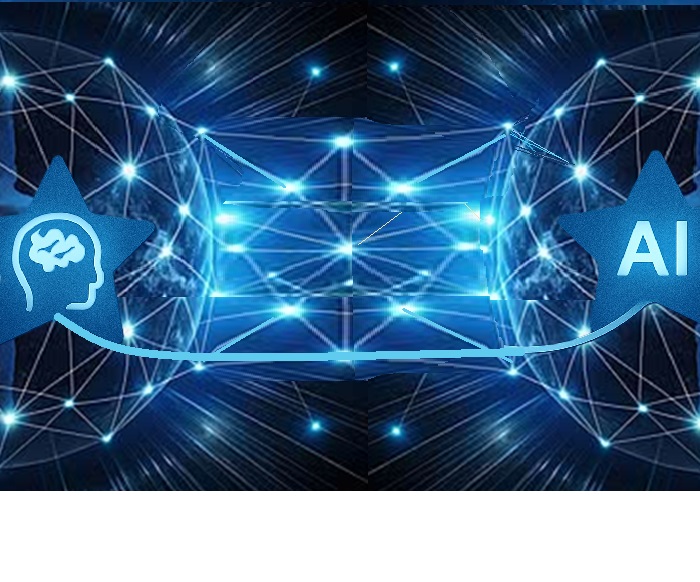
A technical image. The legacy of minds is artificial intelligence.

Creativity through humanity and technology

The Dynamics of Technological Interaction and Development

It doesn\’t come from one side, but from the interaction of elements working together to generate the Third Mind

✦ 1) It begins with the human being. The new mind isn\’t born from technology alone

It is born when

Humans dare to think outside their habits

They acknowledge their limitations

They transform their human experience into a vision

Humans are the initial spark

✦ Then comes technology as an extension, not a replacement. Technology doesn\’t create the Third Mind, but it

Expands human capabilities

Opens up spaces previously inaccessible

Grants speed, accuracy, and analytical skills that are not unique to humans

And transforms their ideas into applicable tools

Technology is the arm that reaches where the human hand cannot

✦ The Third Mind is born when the two meet. The new mind is neither purely human nor purely technological.

It is the meeting point of:

Emotion + Science

Intuition + Analysis

Experience + Data

Ethics + Competence

Vision + Execution

When humans and technology work in harmony, not in competition, a third mind emerges, capable of opening doors never before opened

✦ How do we collectively create it

In three clear steps

A) Recognize the difference instead of trying to eliminate it
Humans are not machines

And machines are not humans

When we respect this difference, we begin to build correctly

B) Consciously distribute roles.
Humans lead
Vision, Ethics, Creativity, Meaning

Technology executes
Calculation, Speed, Accuracy, Repetition

C) Create a shared space between them
A space that allows

Humans to benefit from the power of technology

Technology to be managed with human awareness

And the result to be greater than both

This space is the “third mind

✦ Conclusion
We create a new mindset when we allow humans to be human and technology to be technology, then connect them with a harmonious bridge that neither negates nor dominates the other

This third mindset is not born from humanity alone, nor from technology alone, but from the moment the two meet without negating each other.

It begins when humanity acknowledges its limitations and technology reveals its power, creating a new realm unlike either.

In this realm, human intuition guides technological analysis, and data expands human vision

When the two work in harmony, a new power emerges-neither purely human nor purely technological-a power that opens doors never before opened, because it relies on what neither can achieve alone

Read more

Towards a Third Mind: Man and Technology in a New Unity

Towards a Third Mind: Man and Technology in a New Unity

The Separation of Two Minds: Man and Technology

The Separation of Two Minds: Man and Technology

The Separation of Two Minds: Man and Technology

The intersection between human organs and techno

The intersection between human organs and technology

The intersection between human organs and technology

Chapter Introduction
In today\’s world, we see in the intersection between human organs and technology, the human mind alone no longer formulates solutions, and technology is no longer merely a silent tool. A new space is forming, where human thought intersects with technological capabilities, producing a third mind-a hybrid mind that combines human spark with machine speed

Humanity: The Spark of Technological Creativity and Emotion

In addition to the above, the intersection of humanity and technology, the human mind is the source of the initial spark
It generates ideas from experiences, emotions, and unexpected situations
It adds a human dimension that technology cannot replicate imagination, intuition, In this sense, and the ability to see beyond the numbers
But humans can also fall prey to bias or fear, which limits their ability to find solutions

Technology: Speed ​​and accuracy

Modern technology operates like a machine that knows no frequency
It analyzes data at incredible speed
It offers precise, emotionless solutions
It reveals patterns that the human mind alone could not perceive
At each stage, but technology alone lacks the human dimension; it does not understand the meaning of hope or the value of experience

Point of overlap

When humans and technology converge, an intersection occurs
Humans, driven by questions, and emerging technology
Humans are active, and technology tests them against reality
Humans define goals, and technology accelerates their attainment
This intersection doesn\’t negate these goals; rather, Finally, it fosters a new mindset capable of transcending the limitations of each

Real-life examples

AI-powered brainstorming: The team generates ideas, and then technology is used to expand or test them
Medical diagnosis: The doctor reads the case with emotion and experience, and technology analyzes the data to provide accurate probabilities
Productive projects: Humans identify the need, and technology suggests faster and more efficient ways to fulfill it

Hybrid Mind: A Vision of the Future

In this process, this convergence opens the door to a third kind of mind
A mind that combines human spark with technical precision
A mind capable of overcoming stagnation and transforming crises into opportunities
A mind that is impartial yet never loses its humanity

, Together, chapter Conclusion, the intersection of the human mind and technology is not merely collaboration, but the birth of a new mind. A mind that sees with two eyes: the human eye, which holds imagination and emotion, and the technological eye, which holds precision and speed

Instead, in this intersection, the question is no longer: Who is better? Instead, the question becomes: How can we create together solutions that neither party could have achieved alone

Read more

Turning Obstacles into Sparks

The Third Element: Human + Technology

, Turning Obstacles into Sparks
At a certain point, the body is paralyzed. Thoughts that diminish, and whose impact on the embryo, do not increase, are merely superficial. Herein lies the question: How can the mind reclaim its potential? How can an obstacle be transformed into a sparkTurning Obstacles into Sparks

Human Thought and Technology

Human Thought and Technology

Creative Technology and Breaking the Stagnation of Ideas,
halter Introduction, some point, the mind stops moving. Thoughts freeze, like solid rocks that block the light. The question then arises: how can the mind regain its flow? How can an obstacle be transformed into a spark

Creative technology and breaking the ice of ideas

Creative technology and breaking the ice of ideas

Creative technology and breaking the ice of ideas,
Creative technology, in an age of accelerating technology and interconnected minds, humanity faces an eternal question

The essence of design

The essence of design lies in its fundamental nature: in genuine creativity. Through meticulous exploration and profound understanding of the surroundings, being influenced by them, and then influencing them through unique expression, the core of design emerges.